

Continuing the event management riff, one of the key areas where a technical writer can add value is by applying his or her schedule-making and -keeping skills. You might be the keeper of the schedule or the event manager or both. You also might have to coordinate your schedule with the event hotel, site locations, and overall organization. Regardless, your ability to track and accomplish multiple tasks simultaneously will serve you well as you’re preparing to execute a large event, such as a conference.
The Tools
You might be familiar with tools such as Microsoft Project, which can do things like establish Gantt charts for schedule tracking. These charts appear as horizontal bar graphs, with each individual task appearing as a separate bar and the horizontal (X) axis being calendar days or weeks. The chart includes a vertical line indicating where you are in time as well as vertical arrows pointing from one task to another if one activity depends on another being completed before it can begin (see image below).
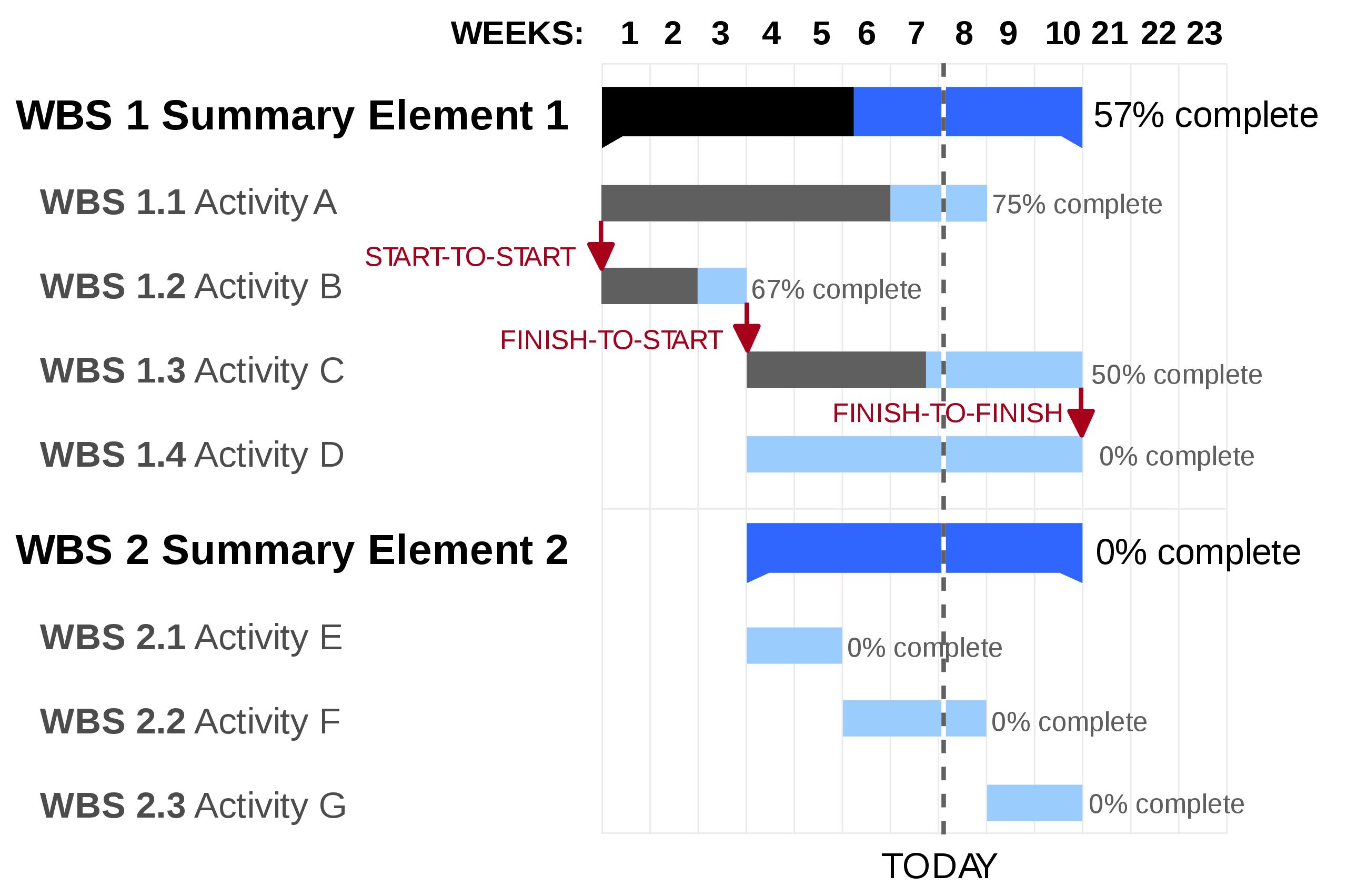
Gantt Chart sample (Source: Wikipedia.org)

Event calendars are useful in that they include deadlines. If there was no specific date for the event to occur, there would be no way to prioritize work and nothing would get done.
You KNOW the date(s) of the event, you know how much time you’ve been given. From there, you apply (C. Northcote) Parkinson’s law that “work expands so as to fill the time available for its completion.” The Gantt chart tracks how you fill your time between your planning start date and the date(s) of the actual event. In most cases, it is not a matter of asking how long it takes to get something done, but rather how much time do you have and what can you and your team do to ensure that the tasks are done within the amount of time given?
My buddy Keith Heitzman is a scheduler with a NASA contractor. His advice, when working with a scheduling tool like Microsoft Project is as follows:
The right way to do is work left to right. Force the start date in the first milestone and then link tasks with logic and give the tasks durations. Project will calculate a finish date. Then you can move the start left or right to get the desired finish.
In an ideal situation, you get the logic and duration right first. Then add the start date last.
The next step is assigning the appropriate amount of margin. Human nature is usually too optimistic. For that reason schedules are almost always too short.
You should also consider a healthy “fudge factor” (also called “schedule margin”) in timing your activities. What do I mean by that? It’s essentially a certain amount of “padding” you add to your activities. It might take longer than you expect for speakers to confirm their attendance or for attendees to register for the event. You can handle these activities by providing public and internal deadlines for various activities. For example, the deadline you publish on your website for speakers or attendees to register might be 3-7 days (3-5 business days) earlier than the actual deadline for making food and beverage or program decisions. That way, you can handle latecomers without too much stress.
As Keith put it,
Human nature is usually too optimistic. For that reason schedules are almost always too short.
And this comes from a guy who makes schedules for a living!
Other Considerations
Between your project start date and end date, there are likely to be some preliminary milestones/deadlines as well, such as:
- Hotel room block cut date: This would be the last date attendees can make a reservation before the hotel releases the remaining rooms in the group’s block to general (non-event) guests.
- Convention space booking date: This would be the deadline for exhibitors to book a booth on the exhibition floor (because the hotel and your event are not going to want people trying to move in last-minute vendors once the floor is open).
- Program and agenda publishing deadlines: If you plan to have a printed program, you usually have to obtain an estimate of how many programs you expect to print, at what quality, and how long it will take the printer to deliver the correct number at the preferred quality in time to hand out to the attendees (and this also must factor in editing/proofreading time).
- Note: Event agendas and websites are increasingly going electronic, both to save printing costs and to be more flexible.
- Speaker invite deadline: This deadline is, more or less, dependent upon the program publishing deadline. You should have your speaker(s) lined up before you publish your event agenda. Otherwise, you have to make last-minute announcements or include an errata sheet in the printed program during the event.
- Food & beverage cut date(s): Food and beverage (F&B) cut dates are often set by the hotel or convention center to ensure that they have an accurate count of meals they need to prepare, beverages they need to provide, tables and chairs they need for setup, and staff members they need to have on hand to operate the event. Usually, you would negotiate many of these numbers in advance. Once you hit the cut date, the event food and beverage manager will still include a certain number of extra meals or other food items to account for last-minute additions. When in doubt, ask the F&B manager what their margin is.
Managing to Your Schedule
It’s important that you work with your team members to ensure that they are staying on schedule. When in doubt, ask them for specifics about their progress: how many people have registered? How many rooms have been filled in the event hotel block? How many speaker slots have been filled? If your team member is having a problem getting people to respond, you might need to work with your outreach or public relations lead to get the word out or contact people individually regarding their deadline for response. If they can’t respond in a timely manner, they can’t participate, unless some heroic, last-minute effort is made. Such things can happen, but it’s better not to depend on them.